Monday, 23 March 2020

Proletarians

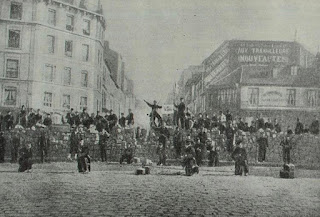
Proletarians, who are pushed into despair, will grab the torch by doing what Stephens advised them; A feeling of revenge will come out, combined with anger that will not be enough to explain the anger of 1793.The war of the poor against the rich will be the bloodiest ever.The union of a part of the bourgeoisie with the proletariat, and even the bourgeoisie's resurgence, will not work.

Moreover, the bourgeoisie's coming to faith only goes from one point to the most, to a moderate juste-milieu (middle way) point; the more obscure, the united with the workers, can only create a new Gironde, and it is defeated during strong developments.

The prejudices of an entire class cannot be put aside like an old coat; Especially the prejudices of the hard, narrow and selfish British bourgeoisie cannot be put.

All of these are the safest conclusions that can be made. The bases are to some extent in the undeniable realities of historical development, to some extent concealed in human nature.Prophecy is nowhere easier than in a place like England, where the elements of society are clearly defined and sharply decomposed.

The revolution will surely come; Time is too late for a peaceful solution; but it can be done softer than predicted in the previous . But this depends on the development of the proletariat rather than the development of the bourgeoisie.

To the extent that the proletariat absorbs socialist and communist elements, the blood, revenge and brutality of the revolution will decrease. Communism is in principle above and beyond the separation between the bourgeoisie and the proletariat; it only accepts the historical significance of this separation at the moment, but does not justify it for the future; in reality it wants to close this gap, eliminate all class oppositions. It is for this reason that the proletariat inevitably angered those who persecuted him as the war continued, justified as the most important lever in the start of a worker mobility; but communism goes beyond this anger, because communism is not only a problem of workers, but a problem of humanity.

Saturday, 28 July 2018

Macro Economics


                    Since we've discussed the consumer purchase price index, inflation and unemployment in the last guide, in this guide we'll discuss the monetary growth, of the business cycle and macroeconomics equilibrium in one country economy. This steps all output and income through a series of national accounts. Towards the end of their financial year, all money flow in and out is composed to ascertain the GDP.

                    Real Gross domestic product is the alteration for the distortion due to inflation by quantifying the fiscal output of services and goods in a given year against the costs of a foundation year while nominal Gross domestic product measures output with current year prices. The business cycle.A country economics moves in a comfortable pattern of four bicycles regeneration: slow down in growth or recession. Trough: bottom end of the cycle expansion: growth increases or retrieval of the economy. Peak: top end of the cycle. The normal business cycle experiences constant fluctuations with one cycle leading - regardless of how protracted - to another and the downturn is defined as two consecutive quarters of falling growth in real GDP. When the economics expands: unemployment decreases, inflation starts to increase and the real Gross domestic product rises. And on the flip side, when the economics contracts: unemployment increases, inflation declines as well as the real Gross domestic product falls.3.

                     Macroeconomics Equilibrium Instead of targeting any one cost or provide as in microeconomics the economist employ the dimensions against the cost level and output for the whole economy. This is achieved by adding up all of the totals for of the whole period. Aggregate demand curve The AD measures the association between the total quantity of all output that consumers are willing to buy and the cost level of the output. AD is the amount of what customers, governments, business as well as foreigners, through exports as well as imports spent in the country economy. Aggregate supply curve AC correlates the relationship between the total quantity of final goods and services all manufacturers plan to provide at a given price level. The two curves are utilized to predict changes in the real Gross domestic product and cost levels and the curves reflect what happens in macroeconomics measurement curves.
                 
                    Where this two curves crossover shows macroeconomics equilibrium.I hope this info will assist you to learn more about macroeconomics, if you need more info of the subject above, please visit my home page at: All rights reserved. Any reproducing of the article must have all of the links intact.


Tuesday, 22 May 2018

Game Theory:John NASH

When you do something, it includes strategic calculations to calculate how the other person will react.Bringing together social and economic accomplishments is similar to the chess game in which the players determine the strategy according to what the next move will be in another acting.Until the 1940s, the economic discipline had largely ignored this issue.Economists have assumed that every buyer and seller in the market is small compared to the total size of the market, so no one has the choice to pay for a product or salary paid for a product.According to this logic, individual choices have no effect on the others, and as a result they can be safely ignored.In 1838, however, French economist Antoine Augustin Cournot analyzed how much the two firms would produce based on the idea of ​​what the other company would do.But it was an individual case where these strategic interactions were analyzed.

                 In 1944, American mathematicians John von Neumann and Oskar Morgenstern published revolutionary works called "Theory of Games and Economic Behavior".These mathematicians claimed that many parts of the economic system were governed by a small group of participants, such as large corporations, trade associations or the government.In such a case economic behavior had to be explained on the basis of strategic interactions.They tried to establish general rules about the strategic behavior among people by analyzing simple games of two persons "zero sum" (one person wins and the others loses).It's called game theory.

                 Von Neumann and Morgenstern looked at cooperative games in which players had a number of possible actions, each with its own particular result, or payoff.Players were given the opportunity to assess the situation and agree on an action plan.The real example of such a game was presented by US mathematician Merill Flood,"who allowed his three teenagers to bid for the right for one of them to work a sa babysitter for a maximum payment of $4.They were allowed to discuss the problem and form a coalition, but if they were unable to agree between themselves then the lowest bidder would win. To Flood, there were easy solutions to the problem, such as settling by lot or splitting the proceeds equally. However, his children were unable to find a solution and eventually one of them bid 90 cents to do the work.

Nash Equilibrium

                 At the beginning of the 1950s, John Nash, an American mathematician, examined what happens when players make independent decisions in situations where there is no co-operation, no opportunities for communication or co-operation.It could have been a blissful outcome when collaboration thought that the co-operation of each player would maximize their chances of success.In such games, Nash found an equality situation in which two players did not want to change their behavior.The player chooses the best strategy, thinking that their opponents have chosen the best strategy.In such games, Nash found that no player wanted to change his behavior because "each player's strategy was optimal for the strategy of the next." This was referred to as the Nash equilibrium.

                 After World War II, game theory became very popular and was used especially by RAND (research and development).The task of RAND, founded in 1946 by the USD government, was to use knowledge for national strength.This institution has commissioned mathematicians, economists and other scientists to investigate areas such as game theory, which is thought to be linked to cold war policies in particular.Game theorists who worked in RAND in 1950 developed two examples of non-collaborative games.The first of these is designed to be called "So Long Sucker", which is also psychologically very annoying.This game forces the players to enter the coalition, but as a result you have to deceive your partner to win.According to the reports, the spouses who tried this game were usually returning in separate taxi cabins.


JOHN NASH


Born in 1928 into a middleclass American family, John Nash was labeled as backward at school due to his poor social skills. However, his parents recognized his outstanding academic ability. In 1948, he won a scholarship to Princeton University. His former tutor wrote a one-line letter of recommendation: “This man is a genius.” At Princeton Nash avoided lectures, preferring to develop ideas from scratch. It was there that he developed the ideas on game theory that were to earn him his Nobel Prize. In the 1950s he worked
at the RAND Corporation and MIT (Massachusetts Institute of Technology), but by now his mental state was worsening. In 1961, his wife committed him for treatment for his schizophrenia. Nash battled with the condition for the next 25 years but never stopped hoping that he would be able to add something else of value to the study of mathematics.


Monday, 14 May 2018

GDP Ignores Women

The Gross Domestic Product is the most considered economic statistic.It provides a summary measure of economic activity in a country over a period of one year - it is directly related to key factors such as household incomes or employment rate.However, in despite of renowned in economics discussions,GDP has engrossing problems.

                 At the center of GDP problems and its limits presents, the calculation type and what its comprise.The calculation of GDP is based on the collection of data on economic transactions.The underlying principle is that everything bought and sold within a year must be passed on to the GDP. Government-affiliated economists conduct in-depth research to measure this figure.But everything bought and sold within this nation is not equivalent to all the economic activity that takes place.In the same way, the figure that emerges at the end does not much necessarily mean the things that people value in a country.For example, an environmentalist said that GDP is not a source of natural resources. Assuming that the GDP is sold, it usually takes into consideration for the cutting of trees.But what is consumed is a natural resource that can not be replaced, and the GDP will not register it.In a similar fashion, when an economic activity produces pollution, GDP ignores unwanted side effects such as loss of biodiversity or worsening public health by looking at only the products sold.

Women at Work

                 Marilyn Waring, who was a deputy in Brazil, claimed that in 1988 If Women Counted GDP was systematically lost to women's jobs at a low rate.Most of the jobs, children and elderly care performed in places around the world are mostly part of women.It is clear that this labor is economically necessary, since it contributes to guaranteeing the reproduction of the labor power. However, it is usually not charged and therefore not included in the GDP calculation.

Excluding Women

                 Differences in what is recorded in the calculation of economic production can be quite enjoyable when the work that is essentially the same is handled in a very different way.Cooking, when food is sold, is "economically active." However, it is not "economically active" when it is not sold.The only distinction here is whether a market operation is the subject matter, but the activity is identical.One will exclude women, one will not.In this case, national accounting implicitly implies a tremendous gender prejudice, and in our traditional accounting systems, the true economic value of women's work is systematically underestimated.Waring further argued that the United Nations System of National Accounts (UNSNA), an international standard system used in the calculation of national income, constituted an example of "applied male domination": In other words, is an attempt to exclude women.

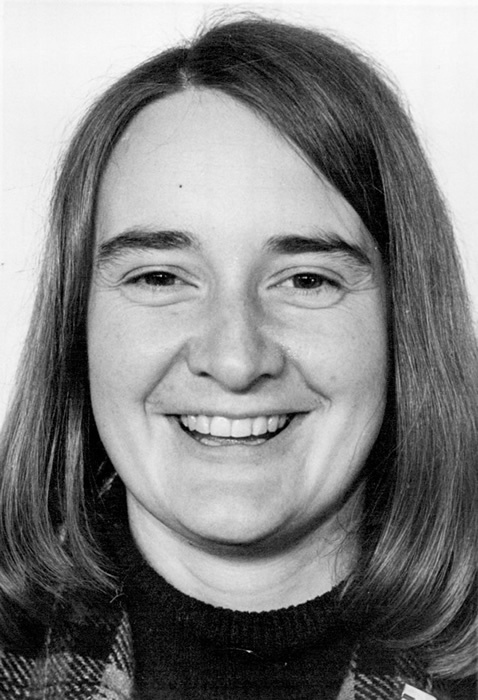
Marylin Waring

Country and Birth : New Zealand-1952

Marylin Waring in 1975.

Marilyn Waring is an internationally-renowned feminist, economist and human rights activist.

Aged just 23 when she was elected to Parliament in 1975, she became the youngest MP in the House. She had worked for the National Party research unit and volunteered with the Women’s Electoral Lobby. Asked why she had gone into politics, she recalled:

No one reason. Partly academic interest, I was interested in the selection process and also I thought we’d done enough criticizing about women not being prepared to put forward their names as candidates for political positions. I couldn’t stand back and criticize them for not doing that if I didn’t do anything myself.

Waring’s maiden speech set out some key priorities that continued throughout her nine years in Parliament.

I realise that I am the youngest member of this House and I would not presume to teach any members of this House anything about politics. But members should be well aware that occasions will arise when I feel that further representation should be given to the point of view of the youth and the women of this country who are grossly numerically under-represented in this House. From time to time, when I feel the pressing need to advance the interests of those two groups, I will do so.
As the member for Raglan (later Waipa), Waring felt a strong duty to represent the people of her rural electorate. But as she said in her maiden speech, women and youth were under-represented in the corridors of power. She believed feminists should work within the system to make positive changes for women.

Waring was one of only four female MPs during her first term and half the average age of MPs. She sought to represent the views of women and youth on contentious issues such as abortion, rape and New Zealand’s anti-nuclear stance.

Marilyn Waring declares her office a nuclear free zone, c.1984

Waring’s support for the Labour opposition’s anti-nuclear bill in 1984 demonstrated a commitment to her values and principles. After being blocked from speaking on the nuclear issue, Waring advised the National Party leadership she would cross the floor on the issue. Prime Minister Robert Muldoon responded by calling a snap election which Labour won by a landslide.

Waring retired from politics in 1984, but continued advocating for women’s rights. In August 1984, seething after months of caucus discussion and select committee hearings on rape legislation, Waring penned a column for the Listener entitled ‘What the Law Calls It’. After outlining the current laws concerning and social attitudes about rape in New Zealand, she concluded, ‘Men may not all be rapists at heart, but they must stop their subtle protecting – and perpetuating – if they want women to know this.’

In September 1984, Waring fielded questions from the general public on feminist issues as part of a TVNZ programme, On Line. In the following video Waring answers a question about women in positions of power and reflects on her experiences in Parliament.

After her time in politics, Waring became an academic, gaining a PhD in political economics. Her 1988 book Counting for nothing (sometimes entitled If women counted), analysed economics from a feminist perspective and highlighted the fact that Gross Domestic Product calculations generally exclude the value of women’s unpaid work. This book and her other work on this subject explored the implications of discounting the work of half the world’s population, and informed and changed United Nations policies in this area.

*Biography was citationed.


Sunday, 4 February 2018

Prıces tell you everythıng

Among investors, there is widespread belief that the stock market can "beat" or outrank it.US economist Eugene Fama opposed it.Efficient Capital Markets (1970) claimed that it was not possible to constantly defeat the market.The theory is known as the efficient market hypothesis.

                 Eugene Fama,claimed that all investors were able to access publicly accessible information like competitors, thus reflecting the entirety of fully accessible information on share prices.This is "productive market." Nobody knows what new information will be disclosed, and it is almost impossible for investors to make profit without having access to information that the rival can not reach, or doing illegal "insider trading"

                However behavioral economists are focused on the problems of the hypothesis.Investors are overly reliant on something and point to the weakness of the "herd" instinct to explain it.These problems manifested themselves in the Dotcom balloon of the 1990s and the more recent 2007-2008 financial crisis, when it was held responsible for artificially inflating "irrational zeal" technology shares.

               Following these crises, many observers declared that the theory was unnecessary; some even blamed this theory for collapse.Eugene Fama had to accept that uninformed investors could make the market worse and that prices could be somehow "irrationally".


Monday, 15 January 2018

Why is diamond expensive than water? - Value Paradox

Anne Robert Jasques Turgot,in 1769,he cautioned that in despite of being something that is highly needed water is not considered a valuable thing in wetlands.Seven years later,Adam Smith,carried that one step further:According to him,high amounts do not paid for water in despite of there is nothing valuable more than water.Even though there is a few value in  terms of usage "generally for against diamond are paid very high amounts." he said.So there is a clear dilemma about the value of certain goods and the importance for people.

Marginal Utility

This paradox can be explained with the help of a concept known as marginal utility.Marginal benefit is the amount of pleasure received from the last unit of the consumed goods.In 1889 Austrian economist Eugen Böhm Von Bawerk,explained with the example of a farmer with five sacks of wheat.Farmer puts in order the sacks from more important(own food) to insignificant(for feed the birds).If he lose one of them sacks he will be give up to feed birds.The farmer needs wheat to feed his stomach, but the price he will pay to replace it in the fifth sack is small,because  the fifth sack corresponds to a small pleasure( to feed birds). The water is the something exist abundant;but the diamond is exist rarity.There is a high marginal utility of an extra diamond; so it has much higher value more than an extra jug water.


Saturday, 25 November 2017

Earnıng Money From Money

                  The mankind give debt and take for centuries.5000 years ago,at the age of which civilizations has not started yet,in Mesopotamia(today's Iraq),there is evidence from people that such relationships are being established.However, the modern banking system emerged in Italy in 14th century.The "bank" means come from the word 'banca' which means Italian 'bench' or 'queue'.It called as "Bank" because of banker who sit on bench to carry on the job connections. Italian peninsula in 14th century,was made up of city states that benefited from the moral and material support strength of the pope in Rome.The geographic location of peninsula,was very appropriate to trade between with the developing European Nations, Asia and Africa.In very short time,the wealth began to accumulate especially in Venice and Florence.There are institutions that finance and insure maritime voyages,was began to formation.Florence was focused on production and trade with North Europe.In this way,merchants and financiers in here met at Banco Medici(Medici Bank).

                  Florence, Peruzzi and Bardi as well as the families and people of the valuable assets of the security of the lenders against the lenders to the foreign countries of the money doing business,who hosted various financial services as well as local bankers who bought and sold this money to local businessmen.The bank established by Medici in Giovanni di Bicci in 1397 was different.

                  The Medici Bank financed the trade of long-haul goods such as wool.The Medici Bank was different from the other banks in three issues.First, it was so big. During he brightest of Cosima's son, the son of the founder, there were branch offices in 11 cities, including London, Brussels and Geneva.Secondly, the responsibility for the management of the bank's network was distributed. The branches were managed by the employees. The Medici family in Florence, who kept the name of the family, who oversaw the bank bank, took a large portion of the profits and was a symbol of the bank's solid reputation,Third, the branches collect deposits in large amounts from wealthy customers, thereby increasing the amount of loans they have given as small start-up capital, increasing the bank's profit.

Banking Economy

                  These qualities that make the Medici's success correspond to three economic concepts that are highly connected to today's banking.The first is "scale economies." It is expensive for a person to make a single statutory loan contract, but a bank can prepare 1000 contracts like this one by paying only a fraction of the cost calculated by the cost per contract.Money exchange (cash investment) is more suitable in scale economies.The second is "risk distribution." The Medicies have reduced their problematic credit risk by distributing debts to different geographies.Moreover, minor partners are smarter in giving credit for their share of profits and losses, so that the medicists' commercial banks, which emerged at the end of the 14th century, have undertaken to arrange deposits and loans and to convert foreign currency into local currency. The circulation of the banned and forbidden money is also under surveillance.Moreover, the little partners are smarter in giving credit for the loss of profits from the profits, so they get some of the Medici's riskier on top of them.The merchants wanted to deposit their gains into the bank or borrow money from the bank. For example, a trader could ask for a safe place to hide their gold and get it back immediately when needed.Another was able to borrow money. It was more risky for the bank and it tied the money for a longer time. Finally, the bank began to stand at a "short-term borrowing and long-term debt" balance.This has come to everyone's mind: the bank that folds its deposits into debt money in order to fold its profits and debts and natural profits and to provide a high return on investment of property owners.However;; these activities make the banks weak and vulnerable at the same time: if a large number of depositors wish to draw money from the bank at the same time ("bank attack"), the bank is also in a difficult situation if it pays a large part of the money in return for a long term repayment. This risk is calculated, the advantage of the system is that it can connect depositors and borrowers in a useful way.
Commercial banks emerged at the end of the 14th century, dealing with deposits and credit arrangements, and the conversion of foreign currency into local currency. They also supervised the circulation of banned and prohibited money.
                  In the 14th century Europe, it was a very risky job to finance distance trade. It was both time and distance, which created the so-called "basic problem of trade": the risk of someone being involved with loss of property or money after a business deal was made.To solve this problem, bills of exchange have been invented. A piece of paper in which the buyer is committed to pay a certain amount of money for these goods when they arrive.The seller of the merchandise could sell it to someone else immediately to get cash.The Italian trade banks were specialized in the administration of these bonds in a very short time and formed an international money market.

                 The bank bought the foreign exchange and assumed the buyer's non-payment risk.For this reason it was important to know who would pay for the bank.In order to lend, in general, it is necessary to equip the whole financial world with talent and special knowledge because lack of information can cause serious problems.The credit customers with the lowest repayment probability were the ones who wanted the loan themselves.They usually can not pay back after they receive the credit.One of the most important functions of a bank is to act smartly when giving credit and to prevent "spiritual damage" that will arise when the borrower does not pay for the repayment reflex of the borrower.

Geographical Clustering

                 Banks often concentrate, or cluster, in the same zone to maximize their knowledge and skills.For this reason, financial centers are formed in big cities. Economists call this "network externality".This theory suggests that the benefits of goods and services increase with the size of the goods and services that use them, and with the formation of the clusters, all the banks also benefit from this increased knowledge and skill.Florence had one of these clusters. The diary was in London with specialists in jewelery and transport.

                 In the early 1800s in north, the remote province of the inner part of the country, Shanxi, became the financial center of China. Online clustering methods have emerged through the internet.Due to the convenience of specialization, many types of banks exist today. Some collect deposits, some give mortgages or car loans. The new identity that banks earn brings some information problems as well.For example, cooperative societies and cooperative banks, in which their customers own shares, emerged in the 19th century when social change took place to increase trust between banks and customers.Because their members can control each other and the managers have local knowledge, such occurrences could provide long-term loans that customers need.In some countries such as Germany, such banks made a lot of premiums. Dutch Rabobank and Bangladesh's "microfinance" bank Grameen Bank, which gives a lot of loans in small amounts, is a good example of a cooperative bank model.However, clustering can lead to risky competition and mass psychology. It is important for banks to be reputable because they have fund-conversion functions; the credits they give are riskier than the deposits they collect, the cash becomes later and more difficult.

                 The bad news is the panic.The bankruptcy of a bank creates serious problems for other banks, the state and society. Just as in 1931, following the bankruptcy of Creditanstalt Bank in Austria, people were attracted to the German Mark, the British sterling and then the US dollar, as the deposit holders in the US withdrew their money from the banks and caused the Great Depression.

                 As a result, banking activities have to be regulated. In many countries, strict legislation is being implemented in many respects, from who can open banks to what information they can keep records and what kinds of activities banks can have.

Finance in General

                 Banking is a large part of the financial world, in fact only a part of it.Finance is a collection of activities that connect the needy with more money and those who need more than the money in hand, and conclude this relationship with productivity.Stock exchanges directly connect these needs with stocks (documents that represent a certain portion of the capital, documents that grant ownership benefits), bonds(debt that can be traded) or other instruments.Stock exchanges are physical markets such as the New York Stock Exchange, or regulated markets where transactions are made through computers, such as telephone and international bond markets.This clustering created by trading operations makes long-term investments more liquid because they can be easily sold and converted into cash.Savings can also be pooled to reduce transaction costs and minimize risk.Here are mutual funds, pension funds and insurance companies.


Tuesday, 10 October 2017

What does Equıtable Price?

A lot of us known well what does "to be cheated". Remember how you feel while you are buying an ice-cream in a touristic business and pay an exorbitant price.However,according to well known economics theories "to be cheated" there is no such thing as.The price of anything else is the market price.That is mean,the price people are ready to pay.The moral dimension does not include while price determination in market economies.Basically,the price determine at the equilibrium point of demand and supply.Someone who determines a high price on a goods that sells only tries to push the price up in fact.If the price pushes the buyer to a level that is not ready, the buyer stops buying the goods.Therefore, the selling price will have to pull again down by seller.Market economists argue that the only requirement for prices to be formed is the market and that nothing - including gold - has no core values.


The price which is acceptance by freedomly

                 The view that the price should be determined by the market is completely contradicted by the views expressed by Sumi Theologica, one of the earliest texts written by Sicilian scholar Thomas Aquinas and the remains of marketplaces.According to Aquinas, a monk, price determination is certainly a moral issue; Greed is a great sin. But Aquinas also predicts that if the merchant is deprived of the profits s/he will be abandon the trade, and this will cause the society to be deprived of the goods it needs.

                An equitable price is a price that the honestly informed buyer can freely accept. The seller is like a ship full of cheap spice information near the port it is not obliged to inform the buyer of the conditions that may reduce the price in the future.

               Just as to what should be the "Equitable Minimum Wage" or "Equitable Premium", the price and moral issues are discussed today by both economists and people in the streets.Free market economists who oppose the market intervention, and those who favor government intervention for moral reasons continue to discuss the positive and negative aspects of the rules and restrictions imposed during pricing.


Wednesday, 30 August 2017

Bond Markets

US President Bill Clinton's election campaign manager James Carville says "In the past, I thought that if there is reincarnation were to come back as President, Pope or a baseball player. But now I want to go back as a bond market."

               The international Bond Markets which companies and governments used it for find source,It is not as famous and understandable as the stock market but it is more important and effective than some angles.Bond markets, which determine whether an economy can be borrowed and borrowed at low cost, help determine the course of wars, revolutions and political struggles.It caused important results for every areas of life.Even in peace times,the ability of money creation of government is important for citizens:The higher the interest rate to be paid,it will be higher the borrowing cost of the economy in all other areas.So it is your loss to ignore the Bond Market.

               State bond prices shows reliability of government,how easy it is to create money and how policies are perceived.If a government can't use bond markets,it does about to collapse.

             Basically,the bond market is a bill of debt.It affirms,a fixed amount of money(lump sum) and also will be paid interest in certain periods(generally annually) to owner in future.For instance,typical state of 100,000 US dollars could be termed from 2 years to 50 years and nominally, it creates %4-5 interest yield.If the bonds started to circulation,it could be processed such as New York, London and Tokyo, the international bond markets in the world's financial centers.

             The important thing is rate The source of the real power of the bond market, the fair rate that the market determines for a bond, can be quite different from that on the bond.If the investors believe that the government's a)to go bankrupt or b)to raise inflation (which is like bankruptcy because inflation leads to decrease in value),they will sell the related bonds of government.This situation has a double effect, which reduces the price of the bond and raises the interest rate it will bring.

             Economically,this situation is reasonable:The more risk an asset is, the fewer investors will buy it and The reward(the interest rate) that they have to take to keep it in hand is so high.

             It will bring $ 450 a year to owner in his/her lifetime(10 years,20 years or more).From selling price to whole who is buying bonds, it does mean %4,5 interest rate.Ok then, If the investors lost themselves trust to the American Governments and if the investors start to selling bonds? The price will fall to $9.000 .With this price, $450 interest yields,it will come to %5 for new investors.

            The market value of the bonds is very important since it sets the interest rates that governments will need to offer in order to sell the bonds that they'll print in the future.Every week, in order to find thousands of customers, the interest rates (coupon interest) written on it must be adjusted to the market value of existing bonds.As the required rate increases, borrowing becomes more difficult and the borrower has to go back.World governments regularly issue new bonds as they have to borrow to keep their budget balanced.In USA,most known state bonds are,treasury notes,midterm treasury bond,shortterm treasury note.In UK,it called as Gilt-Edged Securities because it is believed that the state is a credible creditor.

From AAA to C Credit Grades
Bonds -which are printed by companies or states- are among the safest investments.When a company collapsed, bonds owners ,their invests come to top of the receivable; stock owners maybe have to wait until whole money to be paid.But inability of non-payment of debts probability,important issue for investors.Because of that,a complex device has been built to guide the credibility of a particular bond. The establishments which give credit grades,for instance Standard&Poors,Moody's or Fitch,they gradate of state and company bonds by according to the probability of bankruptcy.This grades,the best one grade goes from AAA to C. BAA and higher bonds called as "in investment grade" , the ones which are in lower called as "junk bonds".The interest rates of junk bonds are generally higher to cover the magnitude of bankruptcy risk.

            The origin of bonds At the first time bonds emerged in medieval age Italy.The city-states which is fight with each others,they force to rich citizens to loan to state with a regular interest payment provision.Even if the modern investors do not have to buy bonds,the state mostly in UK and US, become indebted to money to its citizens through pension funds.Pension funds,must transfer a certain amount of most of the cash to government debt because it does the least risky investment choice existing.Until Napoleon era,market was not effective in real term.First,British government was printing bonds named as tontine and consol.At the 20th century first half Nathan Rothschild,became the richest person and maybe became most powerful financier in the World,through his earnings at Europe bond markets.The fact that Rothschild's to give approval an owed country or not, emerged very serious consequences.Most of historian think,the consequence of French defeat at Napoleon wars were caused couldn't pay their debts and could not find enough money for expedition more than strategic military decisions.

            Yield Curve What best reflects the importance of the bond market, perhaps, is that movements in bond interest can give excellent clues about the economic future of an country. Basically yield curve, it measures,state bond diversity of interest in the time.While other variables are in fixed,the interest rates of near-term treasuries should be less than those of the years after the end of the period.It signals to economy will grow and general price level will increase in the future.But, yield curve often reverses.The interest rates of the maturity which will be over soon can be higher than long-term.

           This is a solid picture of the economy being seen close to the recession because interest rates and inflation (This two phenomenon about collapse) indicate that they will fall in future years.It is also an example that everyone's economic fate is bound to the bond market inevitably.

Essence of the Idea
Bonds are the main means by which governments finance themselves.


Friday, 28 July 2017

Taxes

Benjamin Frankin said "In this world nothing can be said to be certain, except death and taxes." in 1789.In fact, he was not the first person to complain about taxes.Governments has tried to collect money by various methods since existence.King William was prepared the Domesday records to find out who will tax;Chinese citizens must pay the income tax since A.C 10.

             Even taxes today,one of the most controversial subjects in policy.President George H.W. Bush still to be remembered "Read my lips:No new taxes." Unfortunately,the fiscal status of State contradicted him and after four years with a few tax increases,the voter makes a choice against him at the next election.

             People since the beginning of history,they were rightly opposed to struggling and taking their money from their hands.Moreover,past collectors more cruel than the current tax collectors.Those days, if the villagers and workers couldn't pay their taxes,they had to sell their wives and sisters as slaves.Having to give taxes without giving direction to the politics (for example, without the right to vote) causes many complaints and eventually the signing of Magna Carta in 1215, the French Revolution, the Boston Tea Party and the American Civil War.
       
              The tax on all these examples,remains on the heap as well as the fact that many citizens of the world today have to give.Those days, in general the taxes less than 10% and not taken annually;there is temporary taxes collected during wars.Today,even in Switzerland, which has never entered the war, an average worker pays 30% of her/his salary.

             The Art of Taxation What changed? Basically, welfare state and social security systems were born in the last half of the 20th century.The countries around the World,promised to pay public securitys pendings,health,education,unemployment,old-age insurances.They had to provide this extra money;because they need to spend more than their old counterparts.Taxation was the solution.

             It's not just income taxes (deductions based on someone's salary).Hereafter governments could choose inside of huge tax menu:Value gain tax(A deductible tax from the sale of an investment that is valued),inheritance tax (the taxes placed on the deceased),estate tax (the taxes placed on real estate);import and export tariff taxes(also known as customs duty),environmental tax(oscillation taxes) and wealth taxes(taxes from one person's assets).

             In lots of country both government and local managements have tax collection authority.The local managements trust to estate taxes,government trust to income taxes.

            In that case,since middle of the 20th century,The taxes assume the task of fund-raising institutions that protect citizens (army, police, emergency services etc.), as well as redistributing wealth among those who are rich and needy.Also in general,as the country gets richer,the taxes will increase which is taken from.

            Smith's Tax Rules He determined four rules for taxation in his book:
  1. People should contribute by proportional with their incomes.This mean the higher earners will pay higher taxes.The progressive income tax applied in lots of countries;high income groups pay taxes higher than poor groups.Both of tax rates and tax invoices is higher.Today, there is an income tax exemption in the increasingly proportional income tax system.After this segment is overpaid, people pay a certain amount of taxes from their salaries to a certain amount,When this amount is exceeded, they pay more taxes and this goes like this.
  2. The taxes don't be arbitrary,must be accurate.Time and payment method should be open to everyone.
  3. The taxes should collect in an appropriate time.
  4. Taxes should not be more than necessary for both the citizen and the state.In other words,the choices people make in their everyday lives should be as effective as very little.Increasing the marginal tax rate can prevent people from working harder.But,it is a very important argument issue because some of people think like the tax system will encourage the people to do "good things" and as a tool to keep him/her away from others.For instance, governments take high taxes from cigarettes and alcohol for public health.
Limits of  the taxation As the taxes increases,people search for the way of payments.As the taxes many governments of the world encountered with that situation.Some of workers be obliged to pay %70 or higher marginal tax rate(o,the tax they pay for every earned extra dollars and pounds).Rather than doing extra work, they started to work less, pay pensions instead of paying extra income, or carry their money to overseas countries.In an age when money can be transferred from one part of the world to another by pressing a single button, it has become very difficult to prevent the overseas transfer of money.That is why governments have to keep their taxes very competitive.However, over time taxes began to overlap on to each other, and each passing day the system beczme more complex and stubborn.Young William Pitt,when he put into action the first income tax of England in 1798, he insisted on that like it just a temporary for Napoleon Wars for defray the war expenditures.

Ricardo Equality

           The theory of Ricardo Equality (took its name exactly from David Ricardo) upholds that governments should not finance tax reduction by taking debt.
            In general tax reduction seems like good way for the reinvigorate the economy: There will be more money in pockets of people and in theory they spend this money.However, governments to borrow money to cover the tax reduction, according to some economists it provides no benefit.Because it will be temporary solution and it will come back with more tax and more less public expenditure in the future.The Theory of Ricardo EqualityEven if it criticizes the unwarranted tax reductions,this idea don't be effective to stop politicians.

What do I mean by all these paragraphs? 
  • "Taxes are as inevitable as death."


Thursday, 15 June 2017

Keynesianism

At the heart of the Keynesian economy is the use of fiscal policies (government spending and taxes) as a means to control the economy. This idea was adopted by one of the most important intellectuals of the 20th century who is named, John Maynard Keynes. Keynes's ideas gave form to Modern World Economy. Keynes is still respected and followed.

                The masterpiece of Keynes when published in 1936 named The General Theory (Employment, Interest and The General Theory of Money) has written in a response to Great Depression. Keynes upheld that governments were a task they had ignored before. This task was about keeping alive the economy during trauma. This book was written to criticize the idea of French Jean-Baptiste Say "Supply creates its own demand".According to Say's idea, product manufacturing was enough to create demand by itself in the general economy.

                 To revive the economies again There was an accepted hypothesis of economies organize themselves until Great Depression. The Invisible Hand left on its own will bring employment and economic efficiency to the optimum level. Keynes was strongly opposed to it. He upholds, during periods of economic downturn, any deduction in demand, will cause an economic downturn with a strong crisis and will increase unemployment. The task of the government is to revive the economy again. The government can make this like to be in debt and use this dept at the public sector as a creation of employment, investing cash in infrastructure problems. Falling interest prices, even if not enough, could revive the economy a little bit.

JOHN MAYNARD KEYNES 1883-1946 
J.M. KEYNES was a rare occasion:An economist who has had the chance to apply his theories.His friends called him as Maynard.He was a respected intellectual throughout his life,He was the member of Bloomsbury like famous authors Virginia Woolf and E.M.Forster.He counseled the Finance Minister during World War I, but his fame came after the war.He guessed that Treaty of Versailles can caused hyperinflation in Germany with a huge foresight.History made him legitimate.He made wealth from stock market but he lost whole of them because of 1926s collapse.With the speculation over the setup sometimes won and sometimes lost.Before he died-shortly after World War 2 - He established his base to IMF and WB with sizeable amount financing guarantee from USA.These two shape the modern economy in the following years.

                 According to Keynes, the extra expenditures the government will make will spread throughout the economy. For instance, it emerges a new workplace for construction companies. The workers of related companies spend money on food, products and services and it prevents the economy from doesn't into crisis. The key to Keynes's argument is the idea of multiplying.

                Suppose the American government ordered a $ 10 billion plane ship to shipbuilding company Northrop Grumman. You might think that this is the $ 10 billion transfer of the economic effect. However, according to the multiplying argument, the effect will be much larger. Northrop Grumman will hire more people, make more profit, and workers will spend their money on consumer goods. Total economic efficiency will increase much more than the initial money, depending on the "consumption tendency" of an average consumer.

                If the 10 million dollars increase the American economic efficiency by around 5 million dollars, multiplying is 0.5, if it increases by 15 million dollars, multiplying is 1.5.

Six Basic Principles According to former presidential adviser Alan Blinder, There are six basic principles behind Keynesianism.
  1. Keynesians uphold that economy is affected by both public and private sector decisions and sometimes they uphold it can be unbalanced at any time.
  2. The Short run, is more important than the long run. The Short runs in unemployment, may cause more harmful things, because it may cause permanent damage problems to the country's economy. This will remind the famous word Keynes "In the Long Run, We're All Dead".
  3. Prices and especially salaries give respond to supply and demand changes more slowly. It means that your unemployment is generally higher or lower than your economy.
  4. Unemployment is usually very high and variable.; the recessions and crises are not an effective market reaction to unpleasant opportunities such as invisible hand dictation, but rather an economic disease.
  5. Governments should stabilize the natural sudden rising and falling actively.
  6. Keynesians be inclined to struggle against unemployment more than struggle against inflation.

                   A controversial theory Keynesianism has always created controversy. Critics of it ask why we should assume that governments will better govern the economy. Economic The Great Depression of the 1930s was overcome by Keynes' ideas. Franklin D.Roosevelt's program known as the "New Deal Order" was presented as a reaction against the crisis, and it was a classic example of the government's incentive to drive the economy by spending billions during the recession. It is still discussed whether the Great Depression ended these policies or the Second World War. But the message from history is that government spending seems to work.

                   After the publishing of General Theory, governments around the world quite increased their spending. They did this for social purposes, such as improving the welfare state that will overcome the consequences of high unemployment as well as they made Keynesianism based on the emphasis that governments should control the economy. These interventions have worked for a long time, inflation and unemployment quite decreased, and the economy grew. But, in the 1970s especially the monetarists have been started to criticize Keynesian policies. Governments that implement fiscal and monetary policies regularly to increase employment would not be able to fine-tune the economy. Such as policies(like tax discounting) the time between the moment of realizing that it is necessary and the effect of policies is very long. The effect of tax reduction on the economy is longer. Even if the politicians are quick to set the issues, it takes time for the regulations to be written and approved. The effect of tax discounting on the economy is longer. Eventually, when the tax discounts started to work, the problem being solved may already be worsened or even extinct.

                    Namely, Keynes come to the fore again in the 2008s crisis. It was understood that the tax discounts, in America, the UK and other countries would not be able to prevent the recession. When It was understood that the tax discounts, in America, the UK and other countries would not be able to prevent the recession, economists upheld governments should apply tax discounting and spending by borrowing. In the end, these policies have been implemented, breaking away from the economic policies of the past twenty-five years. Despite everything, Keynes is back.


       Gist, governments must spend to prevent deepening recessions.


Saturday, 20 May 2017

Renaissance


An Educated Renaissance


1. Hans Holbein’s The Ambassadors, an icon of the Renaissance, yet only discovered in the 19th century. Its enigmatic sitters and objects offer a wealth of insights into the period.


                What catches the eye as much as the gaze of both sitters is the table in the middle of the composition and the objects scattered across its upper and lower tiers. On the lower shelf are two books (a hymn book and a merchant’s arithmetic book), a lute, a terrestrial globe, a case of flutes, a set square, and a pair of dividers. The upper shelf contains a celestial globe, and several extremely specialized scientific instruments: quadrants, sundials, and a torquetum (and navigational aid). 


                 These objects represent the seven liberal arts that provided the basis of a Renaissance education. The three basic arts – grammar, logic, and rhetoric – were known as the trivium. They can be related to the activities of the two sitters. They are ambassadors, trained in the use of texts, but above all skilled in the art of argument and persuasion. The quadrivium referred to arithmetic, music, geometry, and astronomy, all of which are clearly represented in Holbein’s precise depiction of the arithmetic book, the lute, and the scientific instruments.


                 These academic subjects formed the basis of the studia humanitatis, the course of study followed by most young men of the period, more popularly known as humanism. Humanism represented a significant new development in late 14th- and 15th-century Europe that involved the study of the classical texts of Greek and Roman language, culture, politics, and philosophy. The highly flexible nature of the studia humanitatis encouraged the study of a variety of new disciplines that became central to Renaissance thought, such as classical philology, literature, history, and moral philosophy.


                 Holbein is showing that his sitters are themselves ‘New Men’, scholarly but worldly figures, utilizing their learning in pursuit of fame and ambition. The figure on the right is Jean de Dinteville, the French ambassador to the English court of Henry VIII. On the left is his close friend Georges de Selve, bishop of Lavaur.


                 The objects on the table are chosen to suggest that their positions in the worlds of politics and religion are closely connected to their understanding of humanist thinking. The painting implies that knowledge of the disciplines represented by these objects is crucial to worldly ambition and success.

The Darker Side of the Renaissance


                 Yet if we look even more closely at the objects in Holbein’s painting, they lead us to quite another version of the Renaissance. On the lower shelf one of the strings on the lute is broken, a symbol of discord. Next to the lute is an open hymn book, identifiable as the work of the religious reformer Martin Luther. On the right-hand edge of the painting, the curtain is slightly pulled back to reveal a silver crucifix. 

                 These objects draw our attention to religious debate and discord in the Renaissance. When Holbein painted it, Luther’s Protestant ideas were sweeping through Europe, defying the established authority of the Roman Catholic Church. The broken lute is a powerful symbol of the religious conflict characterized by Holbein in his juxtaposition of Lutheran hymn book and Catholic crucifix.Holbein’s Lutheran hymn book is quite clearly a printed book. The invention of printing in the latter half of the 15th century revolutionized the creation, distribution, and understanding of information and knowledge. 

                 Compared to the laborious and often inaccurate copying of manuscripts, printed books were circulated with a speed and accuracy and in quantities previously unimaginable. But the spread of new ideas in print, especially in religion, would also provoke instability, uncertainty, and anxiety, leading artists and thinkers to further question who they were and how they lived in a rapidly expanding world. This relationship between achievement and the anxiety it creates is one of the characteristic features of the Renaissance.

                 Next to Holbein’s Lutheran hymn book sits another printed book, which at first seems more mundane, but which offers another telling dimension of the Renaissance. The book is an instruction manual for merchants in how to calculate profit and loss. Its presence alongside the more ‘cultural’ objects in the painting shows that in the Renaissance business and finance were inextricably connected to culture and art. 

                 While the book alludes to the quadrivium of Renaissance humanist learning, it also points towards an awareness that the cultural achievements of the Renaissance were built on the success of the spheres of trade and finance. As the world grew in size and complexity, new mechanisms for understanding the increasingly invisible circulation of money and goods were required to maximize profit and minimize loss. The result was a renewed interest in disciplines like mathematics as a way of understanding the economics of a progressively global Renaissance world picture.

                 The terrestrial globe behind the merchant’s arithmetic book confirms the expansion of trade and finance as a defining feature of the Renaissance. The globe is one of the most important objects in the painting. Travel, exploration, and discovery were dynamic, controversial aspects of the Renaissance, and Holbein’s globe tells us this in its remarkably up-to-date representation of the world as it was perceived in 1533. Europe is labelled ‘Europa’. 

                 This is itself significant, as the 15th and 16th centuries were the point at which Europe began to be defined as possessing a common political and cultural identity. Prior to this people rarely called themselves ‘European’. Holbein also portrays the recent discoveries made through voyages in Africa and Asia, as well as in the ‘New World’ voyages of Christopher Columbus, begun in 1492, and Ferdinand Magellan’s first circumnavigation of the globe in 1522. These discoveries situated Europe in a rapidly expanding world, but also changed the continent’s relationship with the cultures and communities it encountered.As with the impact of the printing press, and the upheavals in religion, this global expansion bequeathed a double-edged legacy. One of the outcomes was the destruction of indigenous cultures and communities through war and disease, because they were unprepared for or uninterested in adopting European beliefs and ways of living. Along with the cultural, scientific, and technological achievements of the period came religious intolerance, political ignorance, slavery, and massive inequalities in wealth and status – what has been called ‘the darker side of the Renaissance’.

Where and When Was the Renaissance?

                 The Renaissance is usually associated with the Italian city states like Florence, but Italy’s undoubted importance has too often overshadowed the development of new ideas in northern Europe, the Iberian peninsula, the Islamic world, south-east Asia, and Africa. In offering a more global perspective on the nature of the Renaissance, it would be more accurate to refer to a series of ‘Renaissances’ throughout these regions, each with their own highly specific and separate characteristics.These other Renaissances often overlapped and exchanged influences with the more classical and traditionally understood Renaissance centred on Italy. The Renaissance was a remarkably international, fluid, and mobile phenomenon.

                 Today, there is a popular consensus that the term ‘Renaissance’ refers to a profound and enduring upheaval and transformation in culture, politics, art, and society in Europe between the years 1400 and 1600. The word describes both a period in history and a more general ideal of cultural renewal. The term comes from the French for ‘rebirth’. Since the 9th century it has been used to describe the period in European history when the rebirth of intellectual and artistic appreciation of Graeco-Roman culture gave rise to the modern individual as well as the social and cultural institutions that define so many people in the western world today.

                 Art historians often view the Renaissance as beginning as early as the 13th century, with the art of Giotto and Cimabue, and ending in the late 16th century with the work of Michelangelo and Venetian painters like Titian. Literary scholars in the Anglo-American world take a very different perspective, focusing on the rise of vernacular English literature in the 16th and 17th centuries in the poetry and drama of Spenser, Shakespeare, and Milton. 

                 Historians take a different approach again, labelling the period c.1500–1700 as ‘early modern’, rather than ‘Renaissance’. These differences in dating and even naming the Renaissance have become so intense that the validity of the term is now in doubt. Does it have any meaning any more? Is it possible to separate the Renaissance from the Middle Ages that preceded it, and the modern world that came after it? Does it underpin a belief in European cultural superiority? To answer these questions, we need to understand how the term ‘Renaissance’ itself came into being.No 16th-century audience would have recognized the term ‘Renaissance’. 

                 The Italian word rinascita (‘rebirth’) was used in the 16th century to refer to the revival of classical culture. But the specific French word ‘Renaissance’ was not used as a descriptive historical phrase until the middle of the 19th century. The first person to use the term was the French historian Jules Michelet, a French nationalist deeply committed to the egalitarian principles of the French Revolution. Between 1833 and 1862 Michelet worked on his greatest project, the multi–volume History of France. He was a progressive republican, vociferous in his condemnation of both the aristocracy and the church. In 1855 he published his seventh volume of the History, entitled La Renaissance. For him the Renaissance meant:

. . . the discovery of the world and the discovery of man. The sixteenth century . . . went from Columbus to Copernicus, from Copernicus to Galileo, from the discovery of the earth to that of the heavens. Man refound himself.

                 The scientific discoveries of explorers and thinkers like Columbus, Copernicus, and Galileo went hand in hand with more philosophical definitions of individuality that Michelet identified in the writings of Rabelais, Montaigne, and Shakespeare. This new spirit was contrasted with what Michelet viewed as the ‘bizarre and monstrous’ quality of the Middle Ages. To him the Renaissance represented a progressive, democratic condition that celebrated the great virtues he valued – Reason, Truth, Art, and Beauty. According to Michelet, the Renaissance ‘recognized itself as identical at heart with the modern age’.

                 Michelet was the first thinker to define the Renaissance as a decisive historical period in European culture that represented a crucial break with the Middle Ages, and which created a modern understanding of humanity and its place in the world. He also promoted the Renaissance as representing a certain spirit or attitude, as much as referring to a specific historical period. Michelet’s Renaissance does not happen in Italy in the 14th and 15th centuries, as we have come to expect. Instead, his Renaissance takes place in the 16th century. As a French nationalist, Michelet was eager to claim the Renaissance as a French phenomenon. As a republican he also rejected what he saw as 14th-century Italy’s admiration for church and political tyranny as deeply undemocratic, and hence not part of the spirit of the Renaissance.

                 Michelet’s story of the Renaissance was shaped decisively by his own 19th-century circumstances. In fact, the values of Michelet’s Renaissance sound strikingly close to those of his cherished French Revolution: espousing the values of freedom, reason, and democracy, rejecting political and religious tyranny, and enshrining the spirit of freedom and the dignity of ‘man’. Disappointed in the failure of these values in his own time, Michelet went in search of a historical moment where the values of liberty and egalitarianism triumphed and promised a modern world free of tyranny. 

A Global Renaissance

                 One of the problems with the classic definitions of the Renaissance proposed is that they celebrate the achievements of European civilization to the exclusion of all others. It is no coincidence that the period that witnessed the invention of the term was also the moment at which Europe was most aggressively asserting its imperial dominance across the globe. In recent years, alternative approaches to the Renaissance from history, economics, and anthropology have complicated this picture, and offered alternative factors crucial to understanding the Renaissance, but which were dismissed by 19th-century thinkers like Michelet and Burckhardt as irrelevant. This chapter situates the Renaissance within the wider international world. It argues that trade, finance, commodities, patronage, imperial conflict, and the exchange with different cultures were all key elements of the Renaissance. Focusing on these issues offers a different understanding of what shaped the Renaissance. It also leads us to think of the creativity of the Renaissance as not confined to painting, writing, sculpture, and architecture. Other artefacts such as ceramics, textiles, metalwork, and furniture also shaped people’s beliefs and attitudes, even though many of these objects have since been neglected, destroyed, or lost.

               Another famous Renaissance painting that raises many of these issues is Gentile and Giovanni Bellini’s painting Saint Mark 
Gentile and Giovanni Bellini’s Saint Mark Preaching in Alexandria (1504–7) captures Europe’s fascination with the culture, architecture, and communities of the east.

               Preaching in Alexandria, the centrepiece of the Pinacoteca di Brera Renaissance collection in Milan. The Bellini painting depicts St Mark, the founder of the Christian Church in Alexandria, where he was martyred around ad 75, and patron saint of Venice. In the painting Mark stands in a pulpit, preaching to a group of oriental women swathed in white mantles. Behind Mark stands a group of Venetian noblemen, while in front of the saint is an extraordinary array of oriental figures that mingle easily with more Europeans. They include Egyptian Mamluks, North African ‘Moors’, Ottomans, Persians, Ethiopians, and Tartars.

               The drama of the action takes place in the bottom third of the painting; the rest of the canvas is dominated by the dramatic landscape of Alexandria. A domed Byzantine basilica, an imaginative recreation of St Mark’s Alexandrian church, dominates the backdrop. In the piazza Oriental figures converse, some on horseback, others leading camels and a giraffe. The houses that face onto the square are adorned with Egyptian grilles and tiles. Islamic carpets and rugs hang from the windows. The minarets, columns, and pillars that make up the skyline are a mixture of Alexandrian landmarks and the Bellinis’ own invention. The basilica is an eclectic mixture of elements of the Church of San Marco in Venice and Hagia Sophia in Constantinople, while the towers and columns in the distance correspond to some of Alexandria’s most famous landmarks, many of which had already been emulated in the architecture of Venice itself.At first the painting appears to be a pious image of the Christian martyr preaching to a group of ‘unbelievers’, drawing on the classical world so precious to Renaissance thinkers and artists. However, this only tells one side of the story. Although Mark is dressed as an ancient Roman, in keeping with his life in 1st-century Alexandria, the garments of the audience are recognizably late 15th century, as are the surrounding buildings.


               The Bellinis depict the intermingling of communities and cultures in a scene that evokes both the western church and the eastern marketplace. The painting is a combination of two worlds: the contemporary and the classical. At the same time as evoking the world of 1st-century Alexandria and the life of St Mark, the artists are also keen to portray Venice’s relationship with contemporary, late 15th-century Alexandria. Commissioned to paint a story of the history of Venice’s patron saint, they depict St Mark in a contemporary setting that would have been recognizable to many wealthy and influential Venetians. This is a familiar feature of Renaissance art and literature: dressing the contemporary world up in the clothes of the past as a way of understanding the present.

Thursday, 18 May 2017

The Benefits of the Invisible Hand

Smith argued that these three ingredients would lead to a "natural harmony" of interests between workers, landlords, and capitalists.Recall the pin factory, where management and labor had to work together to achieve their ends, and the woolen coat that required the"joint labor" of workmen, merchants, and carriers from around the world. On a general scale, the voluntary self-interest of millions of individuals would create a stable, prosperous society without the need for central direction by the state. His doctrine of enlightened self-interest is often called "the invisible hand," based on a famous passage (paraphrased) from The Wealth of Nations: "By pursuing his own self interest, every individual is led by an invisible hand to promote the public interest" (423).

             Adam Smith's invisible hand doctrine has become a popular metaphor for unfettered market capitalism. Although Smith uses the term only once in The Wealth of Nations, and sparingly elsewhere, the phrase "invisible hand" has come to symbolize the workings of the market economy as well as the workings of natural science (Ylikoski 1995).

             Defenders of market economics use it in a positive way, characterizing the market hand as "gentle" (Harris 1998), "wise" and "far reaching" (Joyce 2001), one that "improves the lives of people" (Bush 2002), while contrasting it with the "visible hand," "the hidden hand,"
"the grabbing hand," "the dead hand," and the "iron fist" of government, whose "invisible foot tramples on people's hopes and destroys their dreams" (Shleifer and Vishny 1998, 3^1; Lindsey 2002; Bush 2002). Critics use contrasting comparisons to express their hostility toward capitalism.To them, the invisible hand of the market may be a "backhand" (Brennan and Pettit 1993), "trembling" and "getting stuck" and "amputated" (Hahn 1982), "palsied" (Stiglitz 2001, 473),"bloody
(Rothschild 2001, 119), and an "iron fist of competition"
(Roemer 1988, 2-3).

             The invisible hand concept has received surprising praise from economists across the political spectrum. One would expect high praise from free-market advocates, of course. Milton Friedman refers to Adam Smith's symbol as a "key insight" into the cooperative, self-regulating "power of the market [to] produce our food, our clothing, our housing" (Friedman and Friedman 1980, 1). "His vision of the way in which the voluntary actions of millions of individuals can be coordinated through a price system without central direction . . . is a highly sophisticated and subtle insight" (Friedman 1978, 17; cf.Friedman 1981).Not to be outdone are Keynesian economists. Despite its imperfections, "the invisible hand has an astonishing capacity to handle a coordination problem of truly enormous proportions," declare William Baumol and Alan Blinder (2001, 214). Frank Hahn honors the invisible hand theory as "astonishing" and an appropriate metaphor."Whatever criticisms I shall level at the theory later, I should like to record that it is a major intellectual achievement. . . . The invisible hand works in harmony [that] leads to the growth in the output of goods which people desire" (Hahn 1982, 1, 4, 8).

Smith's References to the Invisible Hand


             Surprisingly, Adam Smith uses the expression "invisible hand" only three times in his writings. The references are so sparse that economists and political commentators seldom mentioned the invisible hand idea by name in the nineteenth century. No references were made to it during the celebrations of the centenary of The Wealth of Nations in 1876. In fact, in the famed edited volume by Edwin Cannan, published in 1904, the index does not include a separate entry for "invisible hand." The term only became a popular symbol in the twentieth century (Rothschild 2001, 117-18). But this historical fact should not imply that Smith's metaphor is marginal to his philosophy; it is in reality the central element to his philosophy.

               The first mention of the invisible hand is found in Smith's "History of Astronomy," where he discusses superstitious peoples who ascribed unusual events to the handiwork of unseen gods:
Among savages, as well as in the early ages of Heathen antiquity, it is the irregular events of nature only that are ascribed to the agency and power of their gods. Fire burns, and water refreshes; heavy bodies descend and lighter substances fly upwards, by the necessity of their own nature; nor was the invisible hand of Jupiter ever apprehended to be employed in those matters. (Smith 1982, 49)

             A full statement of the invisible hand's economic power occurs in The Theory of Moral Sentiments, when Smith describes some unpleasant rich landlords who in "their natural selfishness and rapacity"pursue "their own vain and insatiable desires." And yet they employ several thousand poor workers to produce luxury products: The rest he [the proprietor] is obliged to distribute . . . among those. . . which are employed in the economy of greatness; all of whom thus derive from his luxury and caprice, that share of the necessaries of life, which they would in vain have expected from his humanity or his justice. . . . [T]hey divide with the poor the produce of all their improvements. They are led by an invisible hand to,... without intending it, without knowing it, advance the interests of the society. (Smith 1982 [1759], 183-85)"The third mention, already quoted above, occurs in a chapter on international trade in The Wealth of Nations, where Smith argues against restrictions on imports, and against the merchants and manufacturers who support their mercantilist views. Here is the complete quotation:As every individual, therefore, endeavours as much as he can both to employ his capital in the support of domestic industry, and so to direct that industry that its produce may be of the greatest value; every individual necessarily labours to render the annual revenue of the society as great as he can. He generally, indeed, neither intends to promote the public interest, nor knows how much he is promoting it.... [A]nd by directing that industry in such a manner as its produce may be of the greatest value, he intends only his own gain, and he is in this, as in many other cases, led by an invisible hand to promote an end which was no part of his intention. Nor is it always the worse for the society that it was no part of it.

             By pursuing his own interest he frequently promotes that of the society more effectually than when he really intends to promote it. I have never known much good done by those who affected to trade for the public good. (Smith 1965 [1776], 423)

Marx and Communism

Yet, like Cain in the Bible, Marx is cursed with a black mark in history.

              His name will forever be associated with the dark side of communism. A spectre is haunting Karl Marx—the history of Lenin, Stalin, Mao, and Pol Pot, and the millions who died and suffered under the "evil empire," as Ronald Reagan called it. Apologists say Marx cannot be held accountable 1. I think German sociologist Max Weber deserves this honour. See Skousen (2001), chapter 10. for his communist followers' atrocities and even assert that Marx would have been one of the first to be executed or sent to the Gulag. Perhaps.

              For one thing, he vehemently opposed press censorship throughout his career. Yet, without Marx, could there have been such a violent revolution and repression? Did not Marx support a "reign of terror" on the bourgeoisie? As one bitter critic put it, "In the name of human progress, Marx has probably caused more death, misery, degradation and despair than any man who ever lived" (Downs 1983, 299).

Marx Engenders Youthful Fanaticism 

              Among schools of thought, no other economist or philosopher engenders so much passion and religious fever as Marx. Above all, Marx was a visionary and a revolutionary idol, not just an economist. In reading The Communist Manifesto, written over 150 years ago, one cannot help feeling the passionate power, the pungent style, and the astonishing simplicity of Marx and Engels's words (1964 [1848]).

              Youthful followers become true believers, and it usually takes them years to grow out of their Marxist addiction. It happened to Robert Heilbroner, Mark Blaug, Whittaker Chambers, and David Horowitz. I even saw it among my students at Rollins College, a decade after Soviet communism had collapsed and Marxism was supposedly dead. In my class, "Survey of Great Economists," I require students to read a book authored by an economist. One student chose The Communist Manifesto.

              After reading it, he came to me and exclaimed with some emotion, "This is incredible! I must do my book report on this!" pointing to his well-marked copy. It was eerie. In my lectures, I did my best to counter Marxian doctrine, but it didn't matter. He was converted. I can easily see how a young revolutionary could be swayed by these unforgettable lines from the polemical Communist Manifesto: A spectre is haunting Europe—the spectre of Communism... The history of all hitherto existing society is the history of class struggles. . . .The bourgeoisie has pitilessly torn asunder the motley feudal ties that bound man to his 'natural superiors,' and has left remaining no other nexus between man and man than naked self-interest, than callous 'cash payment.'...Veiled by political and religious illusions, it has substituted naked, shameless, direct, brutal exploitation. . . . Let the ruling classes tremble at the communistic revolution. The proletarians have nothing to lose but their chains. They have a world to win. WORKING MEN OF.


ALL COUNTRIES, UNITE! (1964 [1848])


              Marshall Berman, a longtime Marxist living in New York City, recounts how he, as a youth, encountered another book by Marx, Economic and Philosophical Manuscripts of1844. This book generated the same kind of fanatic enthusiasm. "Suddenly I was in a sweat, melting, shedding clothes and tears, flashing hot and cold" (Berman 1999, 7)—not from staring at Playboy magazine or trading penny stock for the first time, but from reading Marx!

              In many ways, Marxism has become a quasi-religion, with its slogans, symbols, red banners, hymns, party fellowship, apostles, martyrs, bible, and definitive truth. "Marx had the self-assurance of a prophet who had talked to God. ... He was a poet, prophet, and moralist speaking as a philosopher and economist; his doctrine is not to be tested against mere facts but to be received as ethical-religious truth... Marx was to lead the Chosen People out of slavery to the New Jerusalem Becoming a Marxist or a Communist is like falling in love, an essentially emotional commitment" (Wesson 1976, 29-30, 158). A guidebook for youth was published in 1935 entitled Teachings of Marx for Girls and Boys, authored by protestant minister William Montgomery Brown, highlighted by pictures on the cover of Marx's "greatest pupils," Lenin and Stalin.

Marx's Contributions to Economics

              Few economists break out into other disciplines as did Karl Marx. There's Marx the philosopher, Marx the historian, Marx the political scientist, Marx the sociologist, and Marx the literary critic. He was prolific and wrote unendingly about nearly everything. Even today a compilation of the complete works of Marx and his colleague Friedrich Engels has not been finished. The commentaries on Marx and related subjects are so vast that it would take volumes to tell it all. (On the Internet, Amazon.com lists over 4,000 entries on Marx and communism, second only to Jesus and Christianity.) Thus, our chapter on Marx must of necessity be limited largely to his economic contributions. Even then, Marx the economist is not an easy subject.

              Marx was probably the first major economist to establish his own school of thought, with its own methodology and specialized language. In creating his own school in his classic work, Capital (1976 [1867]), he contrasted his system with that of laissez-faire—as espoused by Adam Smith, J.-B. Say, and David Ricardo, among others. It was Marx who dubbed laissez-faire the "classical school." In developing a Marxist approach to economics, he created his own vocabulary: surplus value, reproduction, bourgeoisie and proletarians, historical materialism, vulgar economy, monopoly capitalism, and so on. He invented the term "capitalism."2 Since Marx, economics has never been the same. Today, there is no universally acceptable macro model of the economy as there is in physics or mathematics—there are only warring schools of economics.