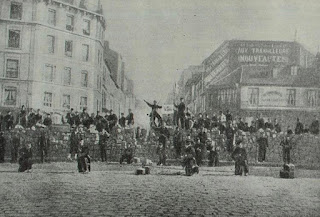
Yet, like Cain in the Bible, Marx is cursed with a black mark in history.
His name will forever be associated with the dark side of communism. A spectre is haunting Karl Marx—the history of Lenin, Stalin, Mao, and Pol Pot, and the millions who died and suffered under the "evil empire," as Ronald Reagan called it. Apologists say Marx cannot be held accountable 1. I think German sociologist Max Weber deserves this honour. See Skousen (2001), chapter 10. for his communist followers' atrocities and even assert that Marx would have been one of the first to be executed or sent to the Gulag. Perhaps.
For one thing, he vehemently opposed press censorship throughout his career. Yet, without Marx, could there have been such a violent revolution and repression? Did not Marx support a "reign of terror" on the bourgeoisie? As one bitter critic put it, "In the name of human progress, Marx has probably caused more death, misery, degradation and despair than any man who ever lived" (Downs 1983, 299).
Among schools of thought, no other economist or philosopher engenders so much passion and religious fever as Marx. Above all, Marx was a visionary and a revolutionary idol, not just an economist. In reading The Communist Manifesto, written over 150 years ago, one cannot help feeling the passionate power, the pungent style, and the astonishing simplicity of Marx and Engels's words (1964 [1848]).
Youthful followers become true believers, and it usually takes them years to grow out of their Marxist addiction. It happened to Robert Heilbroner, Mark Blaug, Whittaker Chambers, and David Horowitz. I even saw it among my students at Rollins College, a decade after Soviet communism had collapsed and Marxism was supposedly dead. In my class, "Survey of Great Economists," I require students to read a book authored by an economist. One student chose The Communist Manifesto.
After reading it, he came to me and exclaimed with some emotion, "This is incredible! I must do my book report on this!" pointing to his well-marked copy. It was eerie. In my lectures, I did my best to counter Marxian doctrine, but it didn't matter. He was converted. I can easily see how a young revolutionary could be swayed by these unforgettable lines from the polemical Communist Manifesto: A spectre is haunting Europe—the spectre of Communism... The history of all hitherto existing society is the history of class struggles. . . .The bourgeoisie has pitilessly torn asunder the motley feudal ties that bound man to his 'natural superiors,' and has left remaining no other nexus between man and man than naked self-interest, than callous 'cash payment.'...Veiled by political and religious illusions, it has substituted naked, shameless, direct, brutal exploitation. . . . Let the ruling classes tremble at the communistic revolution. The proletarians have nothing to lose but their chains. They have a world to win. WORKING MEN OF.
Marshall Berman, a longtime Marxist living in New York City, recounts how he, as a youth, encountered another book by Marx, Economic and Philosophical Manuscripts of1844. This book generated the same kind of fanatic enthusiasm. "Suddenly I was in a sweat, melting, shedding clothes and tears, flashing hot and cold" (Berman 1999, 7)—not from staring at Playboy magazine or trading penny stock for the first time, but from reading Marx!
In many ways, Marxism has become a quasi-religion, with its slogans, symbols, red banners, hymns, party fellowship, apostles, martyrs, bible, and definitive truth. "Marx had the self-assurance of a prophet who had talked to God. ... He was a poet, prophet, and moralist speaking as a philosopher and economist; his doctrine is not to be tested against mere facts but to be received as ethical-religious truth... Marx was to lead the Chosen People out of slavery to the New Jerusalem Becoming a Marxist or a Communist is like falling in love, an essentially emotional commitment" (Wesson 1976, 29-30, 158). A guidebook for youth was published in 1935 entitled Teachings of Marx for Girls and Boys, authored by protestant minister William Montgomery Brown, highlighted by pictures on the cover of Marx's "greatest pupils," Lenin and Stalin.
Few economists break out into other disciplines as did Karl Marx. There's Marx the philosopher, Marx the historian, Marx the political scientist, Marx the sociologist, and Marx the literary critic. He was prolific and wrote unendingly about nearly everything. Even today a compilation of the complete works of Marx and his colleague Friedrich Engels has not been finished. The commentaries on Marx and related subjects are so vast that it would take volumes to tell it all. (On the Internet, Amazon.com lists over 4,000 entries on Marx and communism, second only to Jesus and Christianity.) Thus, our chapter on Marx must of necessity be limited largely to his economic contributions. Even then, Marx the economist is not an easy subject.
Marx was probably the first major economist to establish his own school of thought, with its own methodology and specialized language. In creating his own school in his classic work, Capital (1976 [1867]), he contrasted his system with that of laissez-faire—as espoused by Adam Smith, J.-B. Say, and David Ricardo, among others. It was Marx who dubbed laissez-faire the "classical school." In developing a Marxist approach to economics, he created his own vocabulary: surplus value, reproduction, bourgeoisie and proletarians, historical materialism, vulgar economy, monopoly capitalism, and so on. He invented the term "capitalism."2 Since Marx, economics has never been the same. Today, there is no universally acceptable macro model of the economy as there is in physics or mathematics—there are only warring schools of economics.
His name will forever be associated with the dark side of communism. A spectre is haunting Karl Marx—the history of Lenin, Stalin, Mao, and Pol Pot, and the millions who died and suffered under the "evil empire," as Ronald Reagan called it. Apologists say Marx cannot be held accountable 1. I think German sociologist Max Weber deserves this honour. See Skousen (2001), chapter 10. for his communist followers' atrocities and even assert that Marx would have been one of the first to be executed or sent to the Gulag. Perhaps.
For one thing, he vehemently opposed press censorship throughout his career. Yet, without Marx, could there have been such a violent revolution and repression? Did not Marx support a "reign of terror" on the bourgeoisie? As one bitter critic put it, "In the name of human progress, Marx has probably caused more death, misery, degradation and despair than any man who ever lived" (Downs 1983, 299).
Marx Engenders Youthful Fanaticism
Among schools of thought, no other economist or philosopher engenders so much passion and religious fever as Marx. Above all, Marx was a visionary and a revolutionary idol, not just an economist. In reading The Communist Manifesto, written over 150 years ago, one cannot help feeling the passionate power, the pungent style, and the astonishing simplicity of Marx and Engels's words (1964 [1848]).
Youthful followers become true believers, and it usually takes them years to grow out of their Marxist addiction. It happened to Robert Heilbroner, Mark Blaug, Whittaker Chambers, and David Horowitz. I even saw it among my students at Rollins College, a decade after Soviet communism had collapsed and Marxism was supposedly dead. In my class, "Survey of Great Economists," I require students to read a book authored by an economist. One student chose The Communist Manifesto.
After reading it, he came to me and exclaimed with some emotion, "This is incredible! I must do my book report on this!" pointing to his well-marked copy. It was eerie. In my lectures, I did my best to counter Marxian doctrine, but it didn't matter. He was converted. I can easily see how a young revolutionary could be swayed by these unforgettable lines from the polemical Communist Manifesto: A spectre is haunting Europe—the spectre of Communism... The history of all hitherto existing society is the history of class struggles. . . .The bourgeoisie has pitilessly torn asunder the motley feudal ties that bound man to his 'natural superiors,' and has left remaining no other nexus between man and man than naked self-interest, than callous 'cash payment.'...Veiled by political and religious illusions, it has substituted naked, shameless, direct, brutal exploitation. . . . Let the ruling classes tremble at the communistic revolution. The proletarians have nothing to lose but their chains. They have a world to win. WORKING MEN OF.
ALL COUNTRIES, UNITE! (1964 [1848])
Marshall Berman, a longtime Marxist living in New York City, recounts how he, as a youth, encountered another book by Marx, Economic and Philosophical Manuscripts of1844. This book generated the same kind of fanatic enthusiasm. "Suddenly I was in a sweat, melting, shedding clothes and tears, flashing hot and cold" (Berman 1999, 7)—not from staring at Playboy magazine or trading penny stock for the first time, but from reading Marx!
In many ways, Marxism has become a quasi-religion, with its slogans, symbols, red banners, hymns, party fellowship, apostles, martyrs, bible, and definitive truth. "Marx had the self-assurance of a prophet who had talked to God. ... He was a poet, prophet, and moralist speaking as a philosopher and economist; his doctrine is not to be tested against mere facts but to be received as ethical-religious truth... Marx was to lead the Chosen People out of slavery to the New Jerusalem Becoming a Marxist or a Communist is like falling in love, an essentially emotional commitment" (Wesson 1976, 29-30, 158). A guidebook for youth was published in 1935 entitled Teachings of Marx for Girls and Boys, authored by protestant minister William Montgomery Brown, highlighted by pictures on the cover of Marx's "greatest pupils," Lenin and Stalin.
Marx's Contributions to Economics
Marx was probably the first major economist to establish his own school of thought, with its own methodology and specialized language. In creating his own school in his classic work, Capital (1976 [1867]), he contrasted his system with that of laissez-faire—as espoused by Adam Smith, J.-B. Say, and David Ricardo, among others. It was Marx who dubbed laissez-faire the "classical school." In developing a Marxist approach to economics, he created his own vocabulary: surplus value, reproduction, bourgeoisie and proletarians, historical materialism, vulgar economy, monopoly capitalism, and so on. He invented the term "capitalism."2 Since Marx, economics has never been the same. Today, there is no universally acceptable macro model of the economy as there is in physics or mathematics—there are only warring schools of economics.